
Alright gang, we’re back again for another banger set release, which can only mean another set of Pauper Commander preconstructed decks. Foundations is the first core set we’ve had in a few years, and these sorts of sets are perfect for this format. The designs are clean, broad, and encourage a lot of different synergies while staying easy to process on their face. That said, I decided to go in an interesting direction this time around.
Continue reading “foundations PDH precons!”duskmourn PDH precons!
With the release of Duskmourn comes the release of another set of Pauper Commander preconstructed decks. I want to get into my goals for this project first, and then we’ll get into the decks themselves. Deal? Deal.
Continue reading “duskmourn PDH precons!”dereks strobe night
March of the Machine has been out in the wild for little while now, and it’s definitely made its mark as a really powerful set for Pauper Commander. There are an impressive amount of functional reprints of powerful effects, new twists on old favorites, and some novel designs at the common level. As far as creatures to occupy the command zone, there wasn’t much that really excited me. The biggest thing that pulls me in, as far as commander options go, is the ability of a card to recontextualize portions of the card pool – cards that make you look at a previously underrepresented card or effect and say to yourself, “Well that sure seems good.” While the set has no shortage of obviously powerful commanders, the only one that really struck me was Xerex Strobe Knight. I had the good fortune to open one during the pre-release event I attended, and boy howdy was it an impressive card, even in a general context. After playing a bunch with it that day in my sealed deck, I was pretty sold on translating it into a full-fledged Pauper Commander deck.
Continue reading “dereks strobe night”pauper oathbreaker
With a brand new shiny light cast onto the Oathbreaker format over the last few weeks, my Pauper Commander-addled brain immediately started to think “what if I build an Oathbreaker deck but it was all commons.” After all the work that’s gone into developing Pauper Commander, surely there is a framework we can use to build a Pauper Oathbreaker variant as well (spoiler alert – there is). What initially started as a fun little how-do-you-do thought experiment amongst friends has garnered some actual interest from real humans on The Internet. As such, I wanted to write something up to set the stage and help folks get the ball rolling.
weaving yarns and telling tales in commander
Casual multiplayer Magic is fundamentally narrative. When the game itself becomes more collaborative, it starts to take on the form of a group storytelling exercise, with the course of the game shifting to fit a classic narrative structure. That is to say:
- Introduction
- Rising action
- Climax
- Falling action
- Resolution
draw me a card youre the card draw man by william joel
If there’s one thing Commander players love, it’s drawing cards. They just can’t get enough. Look at them, falling over themselves to just draw more cards. Lucky for them, there’s no better format out there for drawing cards than Commander. The spells and effects available to a broad spectrum of decks has really made keeping our collective hands fully stocked somewhat trivial. This isn’t a bad thing, but it does set a tough expectation to reconcile when moving from that space into Pauper Commander, and being forced to reckon with just how important card advantage is. Pauper Commander is a format where individual resources matter a lot more, so it’s important to have a good grasp on the sorts of tools at our disposal and how they may differ from the Commander decks we’re used to.
Continue reading “draw me a card youre the card draw man by william joel”what does this do: sylvan ranger
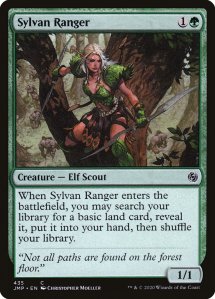
I think it’s easy to look at Sylvan Ranger and very quickly key into what this card does not do and draw some unfavorable comparisons. In fact, it is a much stronger role player than most folks recognize but suffers from being drawn into conversations where it really doesn’t belong.
Continue reading “what does this do: sylvan ranger”heritage druid new and improved: a PRIMER of my fave PAUPER COMMANDER deck
For as long as there have been Magic: the Gathering decks, there have been those built around Elves. Showing up and featured in formats across the history of the game, these little pointy-eared rascals have certainly made a name for themselves as a highly synergistic group of creatures bundled with highly powerful payoffs. The Pauper Commander ecosystem is really no different. I think that Elves are underexplored in the Pauper Commander world, and there are so many great Elf commanders available that each add a unique flavor, depending on what you want to be doing.
For me, what I want to be doing is going fast. That’s what I always found so compelling about Elves as a theme – the ability to put the pedal to the metal and just deploy stuff, hair blowing in the wind. Elves facilitate this experience in a unique way for Pauper Commander, since the format is devoid of any real fast mana the way that we understand it in Commander – there aren’t any Sol Rings, Jeweled Lotuses, Moxen, etc. When it comes to generating the fastest mana in town, I think Elves stand alone; among the bevy of Elf commanders out there, there is none better suited to playing at the speed of light than Heritage Druid.
Continue reading “heritage druid new and improved: a PRIMER of my fave PAUPER COMMANDER deck”where pauper and commander COLLIDE
For as long as there have been Commander players, there have been, in one form or another, Pauper Commander players. No one knows for sure who first uttered the words, “I will build my Elder Dragon Highlander deck with only common cards,” but the idea has, over the years, taken root in the Magic forums of old and grown into what is now a format unto itself.
As the community for Pauper Commander continues to steadily expand and the format garners more attention across various Magic community spaces, I wanted to put together something of a primer. I haven’t written extensively about Pauper Commander in several years now, and it seems fitting that my return to the topic is in service of bringing it to a larger audience. I don’t want to focus exclusively on what the format is, but more so on why it’s worth playing. The few times in years past that Pauper Commander has been featured by larger, more mainstream content creators, it’s been translated in a pretty unflattering way that I feel doesn’t do justice to how approachable, engaging, and enjoyable it really is.
Continue reading “where pauper and commander COLLIDE”flicker decks dont have to be miserable
So I want to return to flicker decks. Whereas my previous foray into my favorite archetype centered on how to go about conceptualizing the sort of flicker deck we want to build and guiding that process, I really want to focus more now on how to integrate card choices into the way we pilot the deck, and how we can make the games a little less tedious. Not to bury the lead here, but I think that flicker decks have an inherent problem where it is very easy to monopolize game time while not meaningfully advancing the state of the game. I love to spin my wheels as much as the next player, but it’s really easy to bring the momentum of a game to a functional halt as we force the other players to watch us grind out value and clutter the stack.
Continue reading “flicker decks dont have to be miserable” commander, dear reader